Class FirstOrDefault
Represents an operator that returns the first element of an observable sequence, or a default value if no such element exists.
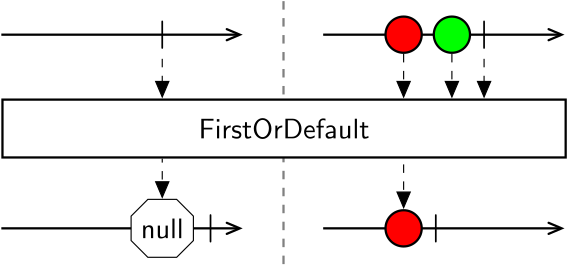
If the sequence has no elements, FirstOrDefault will emit a default value before terminating successfully.
Tip
If you are interested in finding the first element that meets some criteria, consider using the Condition operator before FirstOrDefault.
Warning
There are subtle but important differences between using the FirstOrDefault operator and Take(1):
- When the source sequence has no elements,
Take(1)will complete successfully with no emitted values, whileFirstOrDefaultwill emit a default value before terminating successfully. - When the source sequence emits the first element,
Take(1)will immediately cancel the subscription to the source sequence before emitting the notification.FirstOrDefault, on the other hand, will emit the notification and only afterwards cancel the subscription to the source sequence.
public class FirstOrDefault : Combinator- Inheritance
-
FirstOrDefault
- Inherited Members
Methods
Process<TSource>(IObservable<TSource>)
Returns the first element of an observable sequence, or a default value if no such element exists.
public override IObservable<TSource> Process<TSource>(IObservable<TSource> source)Parameters
sourceIObservable<TSource>The sequence to take the first element from.
Returns
- IObservable<TSource>
An observable sequence containing the first element of the
sourcesequence, or a default value if no such element exists.
Type Parameters
TSourceThe type of the elements in the
sourcesequence.